• Home
    • References
    • Links
  • Inventory
  • Our Nursery
  • Photos
    • Jim Wohl's - Photos
    • Beth Reis's - Photos
    • Korber's - Photos
    • Roger Dahlin's Photos
    • Adventure Unleashed
    • Beth's Garden
    • Gerry's Gentian
    • Jim's Garden
    • Korber's Garden
    • Roger's Garden
    • Suzy's Gardens
    • Sweden's Flower
  • Native Plants
    • Agastache scrophulariifolia
    • Allium cernuum
    • Anemone canadensis
    • Aquilegia canadensis
    • Argentina anserina
    • Arisaema triphyllum
    • Asarum canadense
    • Asclepias exaltata
    • Asclepias incarnata
    • Asclepias purpurascens
    • Asclepias sullivantii
    • Asclepias syriacac
    • Asclepias tuberosa
    • Asclepias verticillata
    • Baptisia australis
    • Blephilia ciliata
    • Blephilia hirsuta
    • Caltha palustris
    • Campanulastrum americanum
    • Chelone glabra
    • Conoclinium coelestinum
    • Dalea purpure
    • Echinacea purpurea
    • Eryngium yuccifolium
    • Eupatorium altissimum
    • Eupatorium perfoliatum
    • Eurybia macrophylla
    • Eutrochium fistulosum
    • Eutrochium purpureum
    • Filipendula rubra
    • Gentiana andrewsii
    • Gentianopsis crinita
    • Geranium maculatum
    • Helenium flexuosum
    • Helianthus grosseserratus
    • Helianthus mollis
    • Helianthus strumosus
    • Helianthus tuberosus
    • Heliopsis helianthoides
    • Hibiscus moscheutos
    • Hydrastis canadensis
    • Impatiens capensis
    • Iris cristata
    • Iris versicolor
    • Liatris spicata
    • Lobelia cardinalis
    • Lobelia siphilitica 'Alba'
    • Lobelia siphilitica
    • Ludwigia alternifolia
    • Lupinus perennis
    • Mertensia virginica
    • Mimulus ringens
    • Monarda didyma
    • Monarda fistulosa
    • Oenothera pilosella
    • Opuntia humifusa
    • Packera aurea
    • Parthenuium integrifolium
    • Penstemon digitalis
    • Penstemon hirsutus
    • Phlox pilosa
    • Physostegia virginiana
    • Podophyllum peltatum
    • Rudbeckia laciniata
    • Polygonatum canaliculatum
    • Pycnanthemum incanum
    • Pycnanthemum tenuifolium
    • Ratibida pinnata
    • Rudbeckia triloba
    • Ruellia humilis
    • Sedum ternatum
    • Senna hebecarpa
    • Silene regia
    • Silene stellata
    • Silene Virginica
    • Silphium laciniatum
    • Silphium perfoliatum
    • Silphium terebinthinaceum
    • Sisyrinchium albidum
    • Solidago flexicaulis
    • Solidago ohiensis
    • Symphyotrichum laeve
    • Symphyotrichum novae-angliae
    • Symphyotrichum shortii
    • Tiarella cordifolia
    • Tradescantia ohiensis
    • Uvularia grandiflora
    • Verbena simplex
    • Verbena stricta
    • Vernonia gigantea
    • Veronicastrum virginicum
    • Viola pedatifida
    • Zizia aurea
  • Contact Us

Symphyotrichum novae-angliae New England Aster

Ohio Native Plant Natural Range

To view the natural range of Symphyotrichum novae-angliae visit the USDA Natural Resources Conservation Service website.
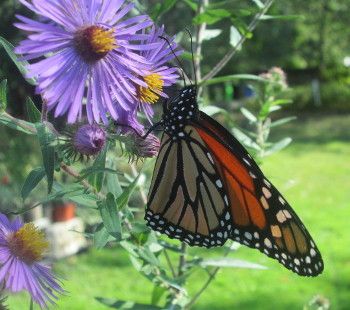
Monarch Butterfly feasting on nectar
Cultivation Information New England Aster
Alternating, clasping, rough and slightly hairy leaves

Height - 4 ft - 5 ft - By the end of the season the New England Aster growing along our fence is monster sized! We utilize the fence and pull the big guy in a bit with old clothesline. Flower Color - Purple, light blue Blooms - August - OctoberSun - Sun to Part Sun Hardy Zone - 3 to 8 Perennial pH - 5.5 to 7 Soil - Average - They seem to do well with soil that is not too dry and not too moist. When New England Asters are happy, you will know it as they fill in nicely and have an abundance of blooms. Family -Asteraceae
Propagation Notes New England Aster
Seed Stratification
Cold/ Moist - storage for 60 days. Outdoors - Sow seed in the fall - provide a simple cold frame covering to protect from elements. Seeds require cold, moist storage in order to germinate Identifying seedlings – When experimenting with new seed, starting them indoors allows one to closely observe unique and specific characteristics.
Suggested reading – Seedling identification - The Tall Grass Prairie Center Guide to Seed and Seedling Identification in the Upper Midwest, By Dave Williams
In the fall New England Aster flowers brighten up the garden!

Wildlife Significance New England Aster

Provides Late Fall Pollen - As a source of protein for:long-tongued bees, bee flies, short-tongue bees and Syrphid flies
Bumble Bees - Assists Queen Bumble Bees in their quest to build pollen reserves for winter
Host Plant - Leaves are food for the Caterpillars of Pear Crescent ButterflyProvides Late Fall Nectar - Butterflies and skippers Seed -
Deer - Mammals are not fond of New England Aster
For detailed information, visit the Illinois Wildflower website

A flock of turkeys discovered my parent's backyard that contains over 100 different native perennials
View from the back - Leaf bracts ofSymphyotrichum novae-angliae
Provenance Symphyotrichum -novae-angliae
Greene County, Ohio, 2021. Volunteer - Nodding Onion Gardens 2012 - to present
Contact
noddingoniongardens@gmail.com
Location
Columbia Station, Oh 44028 US
Ohio Department of Agriculture Nursery Inspection 2009 - 2026
Copyright © All rights 2026

We use cookies to enable essential functionality on our website, and analyze website traffic. By clicking Accept you consent to our use of cookies. Read about how we use cookies.

Your Cookie Settings

We use cookies to enable essential functionality on our website, and analyze website traffic. Read about how we use cookies.

Cookie Categories
Essential

These cookies are strictly necessary to provide you with services available through our websites. You cannot refuse these cookies without impacting how our websites function. You can block or delete them by changing your browser settings, as described under the heading "Managing cookies" in the Privacy and Cookies Policy.

Analytics

These cookies collect information that is used in aggregate form to help us understand how our websites are being used or how effective our marketing campaigns are.